
Overview
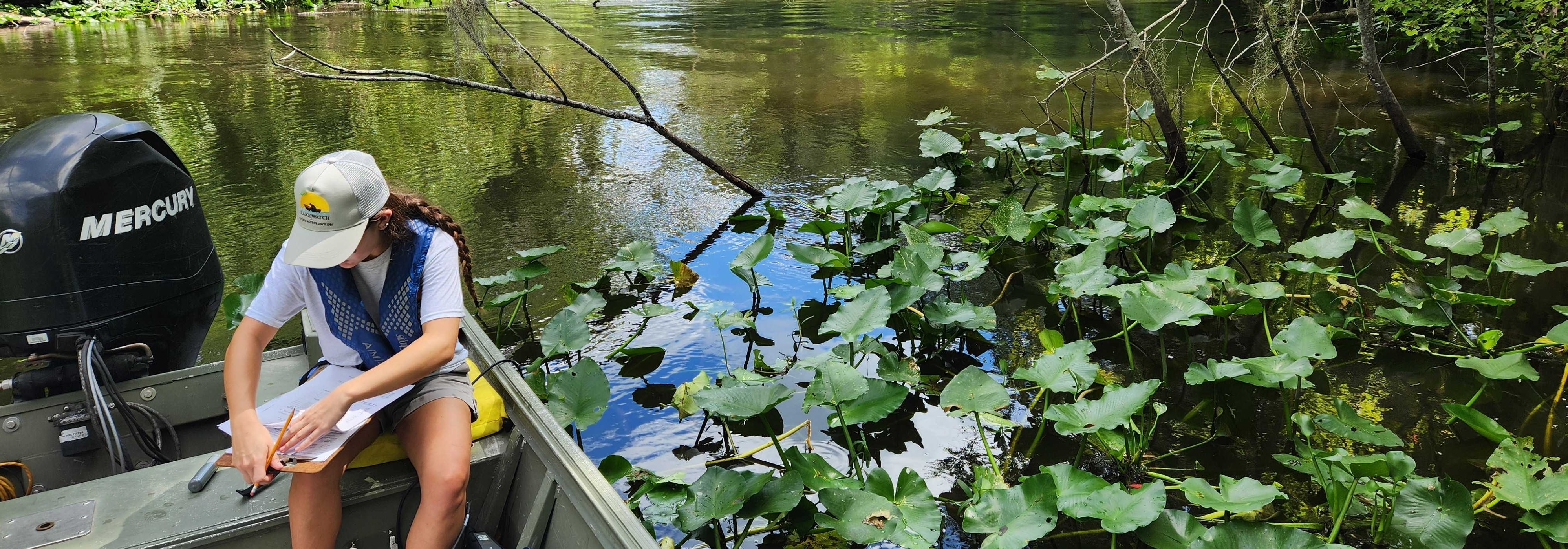
The Florida LAKEWATCH program conducts and supports primary research on limnology and fisheries science. We are broadly interested in freshwater ecology and chemistry. The program has produced meaningful research on water quality (including research based on the long-term water quality sampling conducted by our volunteers) as well as fish population, plant communities, and bacteria levels in freshwater ecosystems within Florida and beyond. Our current research activities have expanded our research scope to also include various pollutants and food web modeling. We are also actively collaborating with social scientists to learn more from our volunteers and inform other citizen science programs on how to recruit and retain their participants.
Because LAKEWATCH data are uploaded to the Watershed Information Network and shared freely with other researchers, many external publications use our information as well, and we may or may not know about them. We ask any user of our data to cite our program and share a copy of their research products with us, so we can tell volunteers about it. Users of our data, please see our citation page for more details.
Water quality monitoring & trends
- Nutrient concentrations (nitrogen & phosphorus) & eutrophication
- Chlorophyll-a and algal biomass measurements
- Water clarity (Secchi depth)
- Seasonal and multi-decadal trend analysis
- Impacts of geology on lake chemistry
Environmental contaminants
- Nutrient enrichment and its effects on lake ecosystems
- Mercury cycling in freshwater, including bioaccumulation and biomagnification patterns
- “Forever Chemicals” or PFAS occurrence and fate in freshwater biota
- Arsenic speciation in fish and risk assessments to consumers
Freshwater ecology
- Fish community surveys
- Studies of benthic invertebrates and other aquatic organisms as ecosystem indicators
- Food web mapping and trophic ecology
- Invasive species impacts on native freshwater invertebrates and fish
Citizen science & data validation
- Understanding volunteer recruitment, retention, and participation in science
- Evaluating the quality of data collected by trained volunteers
- Integrating community-collected samples with professional monitoring
- Collaborating with and supporting other volunteer-based scientific programs
Aquatic plant & habitat research
- Macrophyte surveys (mapping extent and species)
- Role of aquatic vegetation in nutrient cycling, water clarity, and habitat
- Interactions between invasive plants and native lake communities
- Herbicide effectiveness and impacts on aquatic ecosystems
The Florida LAKEWATCH program has contributed to over 60 student theses since its inception. We continue to support graduate and undergraduate student research by direct supervision and mentorship, as well as participating in various committees within UF and our broader scientific societies. Our analytical lab also regularly supports graduate student projects, when our capacity allows.
Students in the LAKEWATCH lab are supervised by Dr. Lescord and are part of the School of Forests, Fisheries, and Geomatics Sciences (SFFGS) at the University of Florida. Information about SFFGS and application guidelines can be found here: https://ffgs.ifas.ufl.edu/academics/apply/. Dr. Lescord also serves on many student committees and participates in other mentoring activities not listed herein.
Prospective students
Specific openings for new LAKEWATCH students change periodically and are detailed here. Alternatively, you are welcome to contact to Dr. Lescord directly (lescord.g@ufl.edu) for more information on upcoming projects. Prospective students are encouraged to include an up-to-date CV and a writing sample when reaching out.
Students interested in working with Dr. Lescord during their online Master of Fisheries and Aquatic Sciences (MFAS) degree or undergraduate students interested in either the University Scholars Program or the IFAS Undergraduate Internship or Honors Thesis Programs are welcome to contact her at lescord.g@ufl.edu.
Current projects
| Celine Lajoie, Postdoctoral fellow, Project: “Understanding temporal changes in mercury accumulation in biota from sub-tropical lakes and rivers” | 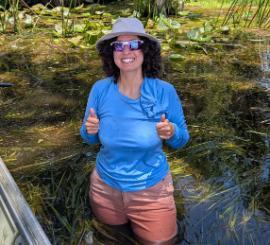 |
| Anthony Johnson, PhD student, Project: “Biological monitoring of 'forever chemicals' in freshwater wildlife” | 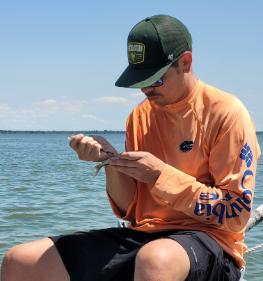 |
| Baylor Lynch, PhD student, Project: “Tracing food web structure and contaminant pathways in Florida's subtropical lakes” | 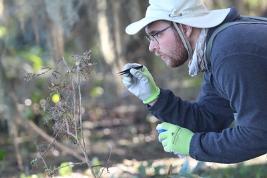 |
| Noah Peterson, MS student, Project: “An ecological assessment of Asian swamp eel impacts on lacustrine food webs in Florida” | 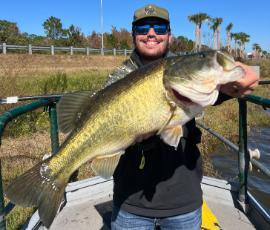 |
| Makenna Gary, MS student, Project: "Impacts of aluminum sulfate (alum) applications on the ecology and chemistry of a subtropical lake" |  |
Past students
Read about the more than 40 past graduate students of Florida LAKEWATCH.
The Florida LAKEWATCH program has led or contributed to hundreds of peer-reviewed publications since its beginnings. Over 100 of these studies were written by LAKEWATCH staff using LAKEWATCH data, including volunteer-generated water quality data and information. Other topics of our past research include freshwater fish populations, communities, and abundances; aquatic plant communities and abundances; lake morphology; bacterial levels; and aquatic bird populations and abundances.
One of the most impactful series of peer-review publications produced by the program shows the accuracy and value of volunteer-generated data for research and management purposes. Those publications include (bold = LAKEWATCH personnel):
- Hoyer, M.V., and Canfield Jr., D.E. 2021. “Volunteer-collected water quality data can be used for science and management.” Lake and Reservoir Management 37(3): 235–245. Taylor & Francis. doi:10.1080/10402381.2021.1876190.
- Hoyer, M.V., Wellendorf, N., Frydenborg, R., Bartlett, D., and Canfield Jr., D.E. 2012. “A comparison between and volunteer collected trophic state chemistry data in Florida.” Lake and Reservoir Management 28(4): 277–281. Taylor & Francis. doi:10.1080/07438141.2012.736016.
- Canfield, D.E., Brown, C.D., Bachmann, R.W., and Hoyer, M.V. 2002. “Volunteer Lake Monitoring: Testing the Reliability of Data Collected by the Florida LAKEWATCH Program.” Lake and Reservoir Management 18(1): 1–9. doi:10.1080/07438140209353924.
A list of recent and select publications relevant to LAKEWATCH volunteers or stakeholders and authored by our staff, students, and other affiliates include (bold = LAKEWATCH personnel):
2025
- Lescord, G.L., C.M. Lajoie, T.R. Lange. In-Press. “Mercury in biota from Florida’s freshwater lakes and rivers: a review of current research and emerging challenges.” Environmental Reviews. DOI: 10.1139/er-2025-0127.
- Bachmann, R.W. 2025. Climate Change for Lakes in the Coterminous United States in Relation to Lake Warming from 1981 to 2023. Water 17(14): 2138. Multidisciplinary Digital Publishing Institute. doi:10.3390/w17142138.
- Lescord, G.L. and A.T. Lepage G. 2025. “Making Waves: Report your quality assurance and control (QA/QC) information when publishing analytical data.” Water Research, DOI: 10.1016/j.watres.2025.123167.
- Miller, S., T.A. Johnston, G.L. Lescord, M.J. Heerschap, H.K. Swanson, W. Keller, J.M. Gunn. 2025. “Muscle sulphur compositions and their relation to mercury concentrations in northern freshwater fishes.” Canadian Journal of Fisheries and Aquatic Sciences. DOI: 10.1139/cjfas-2025-0078.
- Smenderovac, E., Kielstra, B., C. Kluke, T.A. Johnston, S. Bhavsar, R. Mackereth, S. Melles, G.L. Lescord, E.J.S. Emilson. 2025. “A Bayesian mixed-model approach for estimating size-adjusted contaminant concentrations in fish.” Environmental Science and Technology, DOI: 10.1021/acs.est.4c10303.
2024
- Bachmann, R.W., and Canfield Jr, D.E. 2024. “An assessment of air and lake water temperatures (1981-2020) in Florida with a hindcast to 1895.” Florida Scient 87(1).
- Johnston, T.A., P.A. Cott, H.K. Swanson, A.D. Ehrman, G.L. Lescord, A.W. Sumner, P.-L. Savage, K.A. Patterson, R.W.-K. Tang, M.J. Heerschap, J.J. Montgomery, J.M. Gunn. 2024. “Ontogenetic variation in isotopic niche positions of aquatic consumers in boreal lakes.” Aquatic Sciences, DOI: 0.1007/s00027-024-01097-4.
- Lepage, A.T., B. Laird, K. Skinner, J. Gunn, G.L. Lescord. 2024. “Arsenic speciation in freshwater fish: A systematic review with implications for monitoring and research.” Environmental Reviews, in-press, DOI: 10.1139/er-2024-0011. *Awarded the Editor Choice Award in 2024.
- Lepage, A.T., G.L. Lescord, T.A. Johnston, A. Lock, J. Gandhi, J. Gunn. 2024. “Biodilution of organic species of arsenic in freshwater food webs.” Environmental Toxicology and Chemistry (ET&C), DOI: 10.1002/etc.5817.
2023
- Canfield Jr, D.E., Bachmann, R.W., and Hoyer, M.V. 2023. The Florida experience: time for a revitalized and restructured Clean Lakes Program. Lake and Reservoir Management 39(3): 191–212. DOI:10.1080/10402381.2023.2236588.
- Carlson, A.K., and Hoyer, M.V. 2023. Bluegill Population Demographics as Related to Abiotic and Biotic Factors in Florida Lakes. Fishes 8(2): 100. Multidisciplinary Digital Publishing Institute (MDPI).doi:10.3390/fishes8020100.
- Jorge García-Girón, Jani Heino, Lars Baastrup-Spohr, John Clayton, Mary de Winton, Tõnu Feldmann, Camino Fernández-Aláez, Frauke Ecke, Patrick Grillas, Mark V. Hoyer, Agnieszka Kolada, Sarian Kosten, Balázs A. Lukács, Marit Mjelde, Roger P. Mormul, Laila Rhazi, Mouhssine Rhazi, Laura Sass, Jun Xu and Janne Alahuhta. 2023. “Compositional breakpoints of freshwater plant communities across continents” 42(2) 291-301; DOI: 10.23818/limn.42.21.
- Trifari, M., M.J. Wooller, L.D. Rea, T.M. O’Hara, G.L. Lescord, A.C. Parnell, B. D. Barst. 2023. Carbon and nitrogen stable isotopes of amino acids reveal the influence of trophic level and primary production sources on mercury concentrations in fishes from the Aleutian Islands, Alaska. Volume 908, 168242, Science of the Total Environment (STOTEN), DOI: 10.1016/j.scitotenv.2023.168242.
- C. Kluke, G.L. Lescord, T. A. Johnston, B. Kielstra, A. Lock, S. Bhavsa, J. M. Gunn. 2023. Patterns and Drivers of Arsenic Bioaccumulation in Boreal Freshwater Fish of Ontario, Canada. Canadian Journal of Fisheries and Aquatic Science (CJFAS), DOI: 10.1139/cjfas-2022-0106.
2022
- Carlson, A.K., and Hoyer, M.V. 2022. Redear Sunfish Occurrence, Abundance, Growth, and Size Structure as Related to Abiotic and Biotic Factors in Florida Lakes. North American Journal of Fisheries Management 42(3): 775–786. doi:10.1002/nafm.10764.
- Hoyer, M.V., and Canfield Jr., D.E. 2022. A Limnological Yardstick based on phosphorus limitation. Lake and Reservoir Management 38(2): 109–125. Taylor & Francis. doi:10.1080/10402381.2022.2045400.
2021
- Weeks E. N. I., M. V. Hoyer, J. Bennett, M. A. Jackson, J. P. Cud. 2021. Integrated management of the invasive aquatic weed hydrilla with two biological control agents and a reduced-risk herbicide. 60: 23-33. Journal Aquatic Plant Management.